The Cotton Road: Confederate Trade Through Mexico
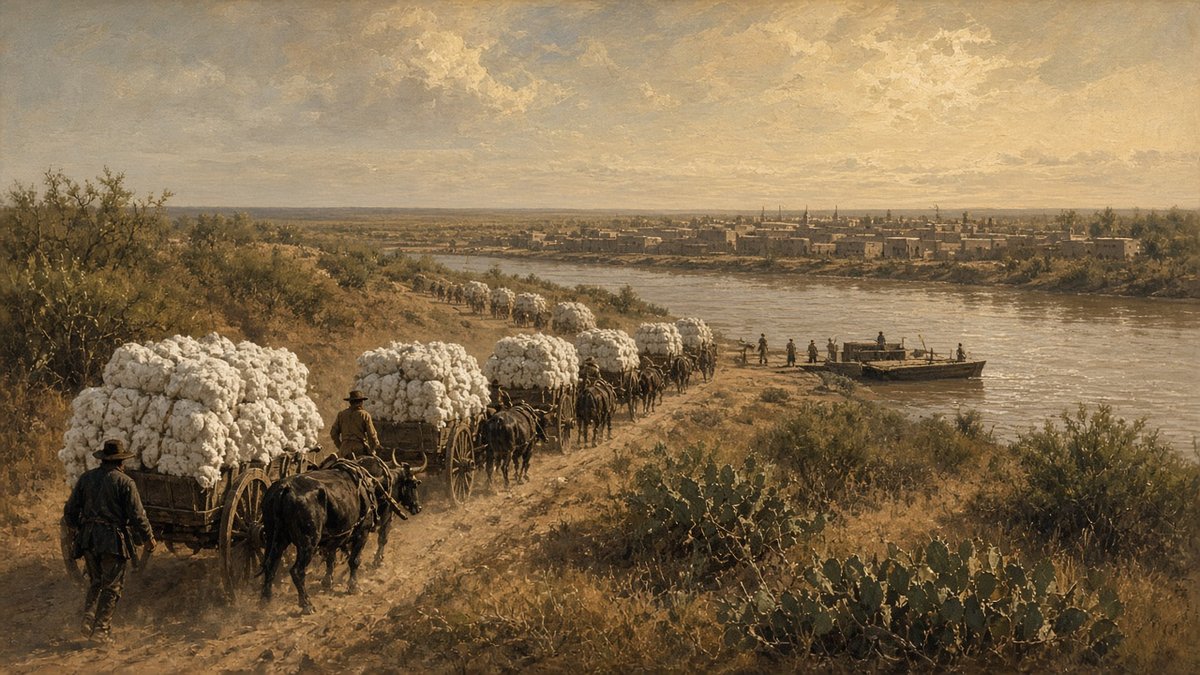
The Union Navy closed Southern ports in 1861, but Texas still had one way out, the Rio Grande. Mexico sat on the far bank as a neutral country, and no blockade could legally stop ships from trading at a Mexican port. So cotton from Texas and beyond went by ox cart and mule train across hundreds of miles of brush country to Brownsville. From there it was carried over the river to Matamoros, then down to Bagdad, a beach town at the mouth of the river. Small boats lightered it out to ships anchored in the Gulf.
Boom on the Rio Grande Matamoros became a boomtown. Bagdad went from a handful of shacks to a port with dozens of ships at a time waiting offshore. British and other European buyers paid in gold, and in goods the Confederacy could not make for itself: rifles, powder, medicine, cloth. Texas cotton was one of the few reliable sources of hard currency the Confederate government had.
The Union tried to close the road. In November 1863 a Federal force landed at the mouth of the Rio Grande and took Brownsville. The cotton trains moved upriver and crossed at Laredo and Eagle Pass instead. In the summer of 1864 most of the Federal troops were pulled out for other campaigns. They left Brownsville on June 29, and on July 30 Confederate troops under John S. "Rip" Ford reoccupied the town. The trade kept going until the war ended.
West of the War follows the cotton road and the men and animals who hauled the bales.
Sources: Texas State Historical Association, Handbook of Texas, "Cotton Trade During the Civil War" and "Bagdad, TX"; James W. Daddysman, The Matamoros Trade: Confederate Commerce, Diplomacy, and Intrigue (1984); Official Records of the War of the Rebellion, Series I, Vol. 26; Texas State Historical Association, Handbook of Texas, "Rio Grande Campaign" and "Brownsville, TX".
Illustration: AI-generated, artistic interpretation.