The Butterfield Overland Mail and the War That Moved It
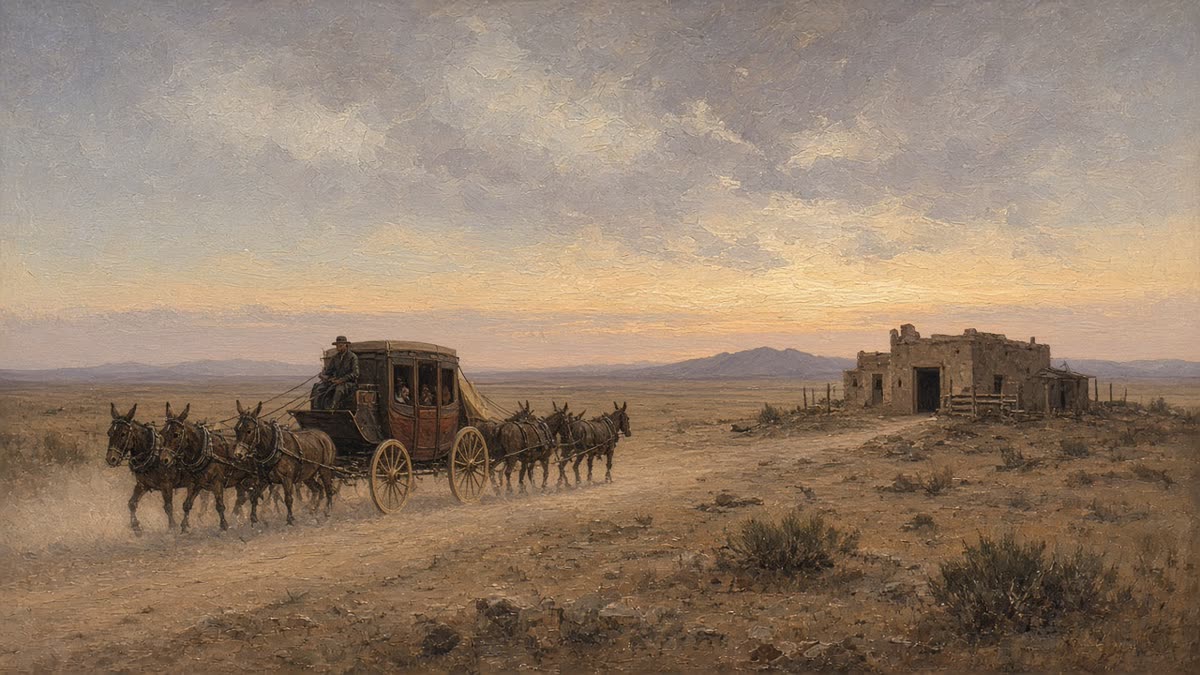
The first Butterfield Overland Mail coaches pulled out of St. Louis and San Francisco in September 1858. The contract called for mail twice a week, with each trip taking 25 days or less. The road didn't go straight west. It bent south in a long arc, through Fort Smith and across Texas, then through El Paso, Mesilla and Tucson, over the Colorado at Yuma, and up across the desert to Los Angeles. Congress and Postmaster General Aaron Brown, who came from Tennessee, chose the southern line because it avoided winter snow. Critics in the North called it the "oxbow route" and suspected Southern interests had shaped the choice.
Why the war closed the southern route
Stations went wherever the teams needed changing, and nowhere else. Passengers rode day and night for roughly 2,800 miles, and the fare west was $200. The line held to its schedule well enough to be the main overland link between the coasts for two and a half years.
The war ended that. Texas left the Union in early 1861, and a mail road through a seceded state could no longer be treated as a federal road. In March 1861 Congress shifted the contract to a central route by way of Salt Lake City. Within months the southern stations stood empty. A year later some of their adobe walls sheltered camps for the armies crossing the same country, with Confederate Texans moving up the Rio Grande and the California Column marching east along much of the old stage road.
Ruins of several stations are still standing. The Butterfield Overland National Historic Trail was designated in 2023, and the National Park Service now maps the route. West of the War follows the soldiers who marched that empty road.
Sources: National Park Service, Butterfield Overland National Historic Trail (nps.gov/buov); Public Law 117-345 (2023); Roscoe P. and Margaret B. Conkling, The Butterfield Overland Mail, 1857-1869 (1947); Texas State Historical Association, Handbook of Texas, "Butterfield Overland Mail."
Illustration: AI-generated, artistic interpretation.